The Double Diamond
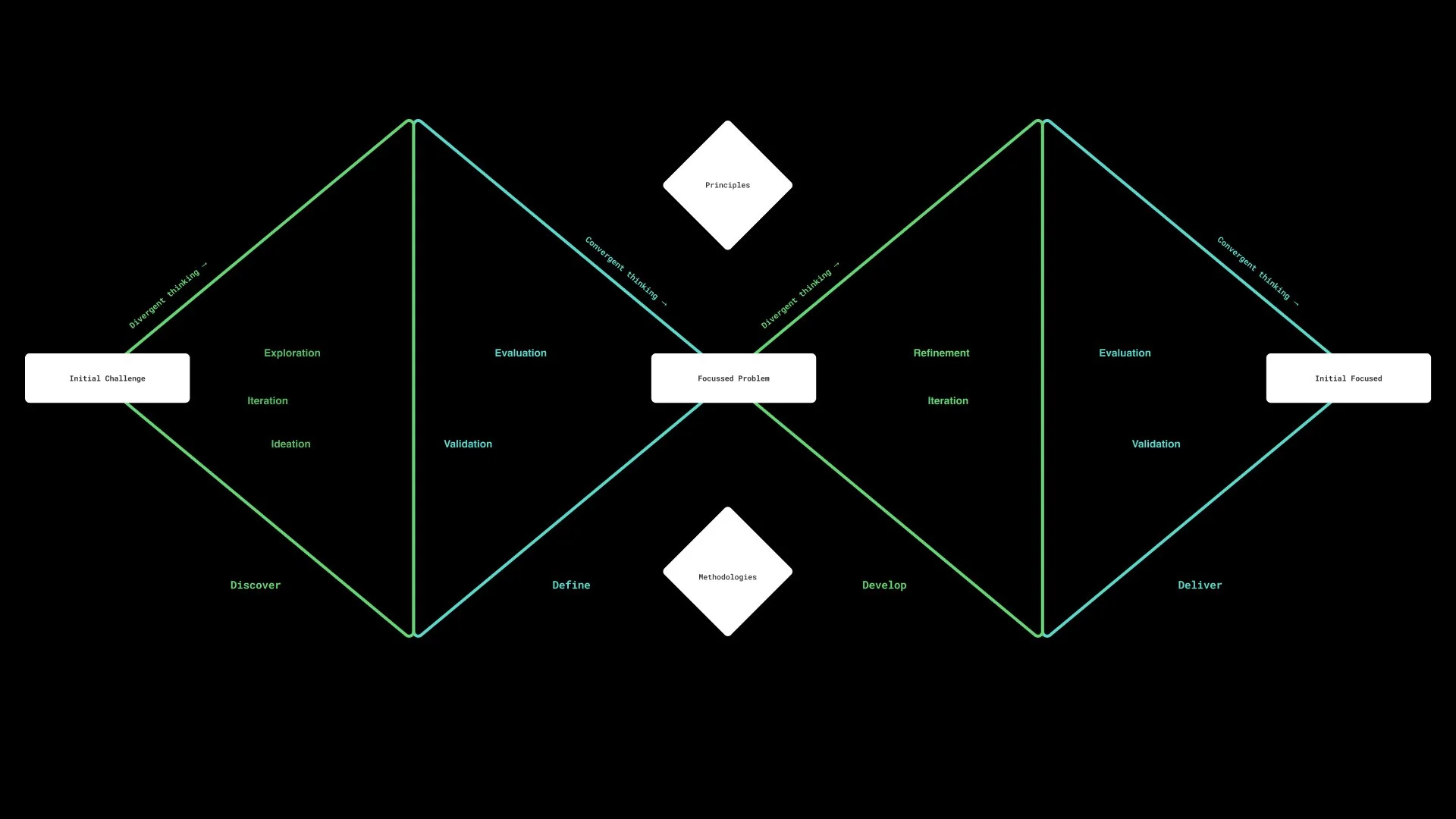
Divergent and convergent action
Two diamonds. Four phases.
Discover. Define. Develop. Deliver.
Neat. Teachable. Downloadable.
But the Double Diamond is not a diagram. It’s a discipline.
Diverge with intention
The first diamond is about expansion.
Explore widely. Ask more questions than you answer. Resist the urge to solve too quickly.
Divergence is uncomfortable because it slows momentum. But it’s where clarity is earned.
In brand and creative work, the biggest risk isn’t bad taste. It’s premature certainty. Teams rush to aesthetics before aligning on the problem. Stakeholders jump to execution before understanding the audience.
This is why it’s critical to create space for teams to fail safely. Build into the process a purposeful pause to research, to have real conversation, to surface tension and contradiction. Allow room to recognize patterns instead of forcing conclusions.
You expand to truly understand what you’re solving.
Converge with courage
Then comes focus.
Not everything deserves to survive. Convergence is where strategy sharpens and decisions get made. This is the moment many teams and individuals avoid. Because choosing one path means letting go of others. What if we’re wrong?
But without convergence, creativity becomes noise.
This is where you tune for signal. A strong Define phase creates a focused problem statement. A disciplined Develop phase shapes options against that lens. And Deliver becomes an opportunity to put your head down and refine with intention.
Convergence is not restriction. It’s commitment.
It’s not linear. It’s rhythmic.
In practice, the Double Diamond isn’t four clean boxes. It’s a rhythm.
Diverge. Converge. Diverge again. Refine. Validate. Iterate.
The best teams understand that exploration and evaluation are partners, not enemies. You make space for imagination, and you build mechanisms for clarity.
When done well, the process creates:
Consistency without rigidity
Innovation without chaos
Speed without recklessness
It builds trust across marketing, product, leadership, and creative.
Why it matters
In complex organizations, creative problems are rarely small. They’re layered with business objectives, stakeholder expectations, and cultural nuance.
I need a simple, repeatable reference point to balance the many tangential thoughts in my own brain. The Double Diamond gives me that anchor.
For me, this isn’t a framework I reference. It’s how I lead.
It’s how I brief.
It’s how I critique.
It’s how I build systems that allow teams to move fast without losing the plot.
Because creativity doesn’t need more chaos.
It needs structure strong enough to let it breathe.
I’ve always admired how IDEO brought Design Thinking into the mainstream conversation. Their work continues to be a reference point in my practice and a reminder that process, when done well, is not restrictive—it’s liberating.